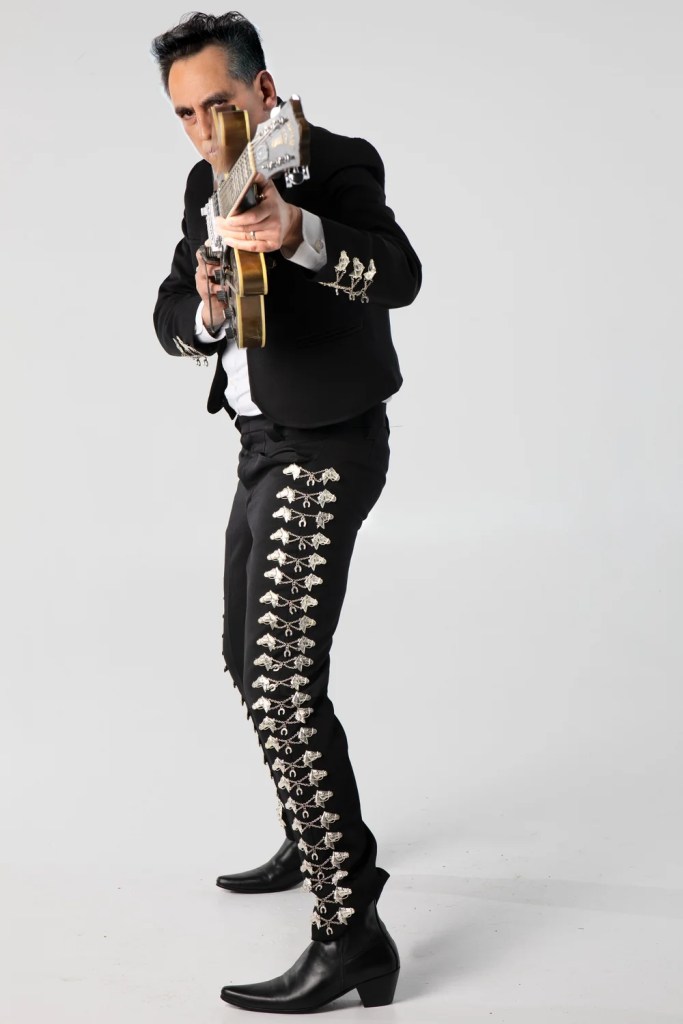
Joshua Josué is a Portland-based Chicano rocker who imbues his music with the spirit of early rock and roll. In this vein, his latest project is Broadcast to the Surf Ballroom (out now). It is a bold and deeply respectful project built around the unfinished demos and fragments left behind by Buddy Holly and Ritchie Valens after their final performance at the Surf Ballroom in Clear Lake, Iowa on February 2, 1959 — just hours before The Day the Music Died. I asked Josué ten questions to explore the passion behind this restorative project.
THE ARGUS FAR FIVE
How would you describe the sound of Joshua Josué?
The sound of Joshua Josué is reminiscent of Early West Coast rock & roll and surf balladry. It is a sound that feels less like a throwback and more like a continuation—music that carries the DNA of early rock & roll, Chicano rhythm & blues, and surf-era, but it speaks in a present voice weaving stories of lone motorcycle trips through Mexico and road-worn narratives. Joshua Josué sounds like early rock & roll carried forward through Chicano identity—quietly modern, deeply intentional, and emotionally close.
What are your biggest non-music influences?
The biggest non-musical influence on my music is travel. I spent years riding a motorcycle through Latin America, much of that time with a Mexican motorcycle club. That experience is where I really found my voice.
The culture across Latin America, the camaraderie within the club, and the long stretches of time spent on desolate backroads and in small towns all shaped how I see and feel things. That way of moving through the world—slow, observant, and connected—found its way into the music.
If you had to cover any song and put a Joshua Josué spin on it, which would you choose?
I’ve always thought ‘Pictures of You’ by The Cure is a song I’d like to reinterpret. There’s something in the way The Cure—and even The Smiths—approach heartbreak that feels deeply familiar to me. I hear that same emotional weight in traditional Mexican voices like Vicente Fernández and Antonio Aguilar. Reimagining ‘Pictures of You’ through that lens—something closer to Vicente’s style—could be something truly special.
What is your earliest memory of music?
My earliest memories of music would be my grandfather sitting on the front stoop on hot summer night in Los Angeles playing his guitar, singing ‘Volver Volver’ and ‘Sabor a Mi’. Sometimes I perform those songs and dedicate them to him.
What does the rest of 2026 have in store for Joshua Josué?
This year is focused on expanding both my touring and my songwriting. Right now, I’m primarily playing shows throughout Oregon, Washington, and Idaho, but I’m working toward taking the music across the continental United States. At the same time, I’m continuing to write and develop new material—building on what I’ve been doing but also letting it grow naturally as I spend more time on the road.
THE JOSHUA JOSUÉ FIVE
What spurred you to embark on this musical journey and finish this collection of demos and ideas yourself?
I had always been drawn to the demos left behind by Ritchie Valens and Buddy Holly. I’d carried those songs with me since high school, playing them over the years, but never feeling like the moment had fully arrived.
Then in the fall of 2025, after a long night of playing guitar and drinking tequila, something settled in. It wasn’t a decision so much as a realization—that the time had come to step into those songs and follow them through.
There’s a kind of quiet weight to those recordings. They’re unfinished, but complete in their own way. I felt a responsibility to approach them with care, and to carry them forward through my own voice—and maybe introduce them to a new audience that had not been exposed to them.
You’ve mentioned that you’ve felt unease with how Buddy Holly’s vocals were ‘preserved’ in a posthumous release of ‘What To Do’. What do you feel when dead artists are revived through AI?
It makes me sick to my stomach people try reviving dead artist through AI. Not only is it disrespectful to the artist but also to fans who cherish those artists.
Which track was the most challenging to finish?
‘Now That You’re Gone’ was probably the most challenging—and the most exciting—to complete. Ritchie recorded it as a loose demo, just him on guitar, singing lyrics and ideas as they came to him.
Because of that, there’s no real structure—no defined verses or choruses. It’s more like a stream of ideas unfolding in real time. Honestly, it feels like there are three or four great songs buried within that one recording.
The challenge was deciding which direction to take it while still staying true to Ritchie’s spirit. In the end, I feel like I was able to find that balance—shaping something complete while keeping the openness and feeling of the original.
‘Oh Selena’ is your ode to Ritchie Valens and Selena, two titans of Chicano music. For people unfamiliar with the genre, where would be the best place to start?
A great place to start is with the films La Bamba and Selena—both are powerful music biopics that give a real sense of who they were, not just as artists but as people.
They were both Mexican American artists who didn’t grow up speaking Spanish fluently, yet chose to sing in Spanish. That’s something I deeply relate to.
From there, you can go into the music itself—because what they created goes beyond genre. It’s about identity, expression, and finding your voice between cultures.
What do you hope listeners get from Broadcast To The Surf Ballroom?
I hope Broadcast To The Surf Ballroom sparks a renewed interest in the music of Ritchie Valens and Buddy Holly—especially the deeper cuts that people might not have heard before. More than anything, I hope listeners can feel the care and intention behind the record. I approached these songs with a deep sense of respect, and I wanted that authenticity to come through in every part of the recording.
Join our (free) mailing list to support the site and never miss an article again!


Leave a comment