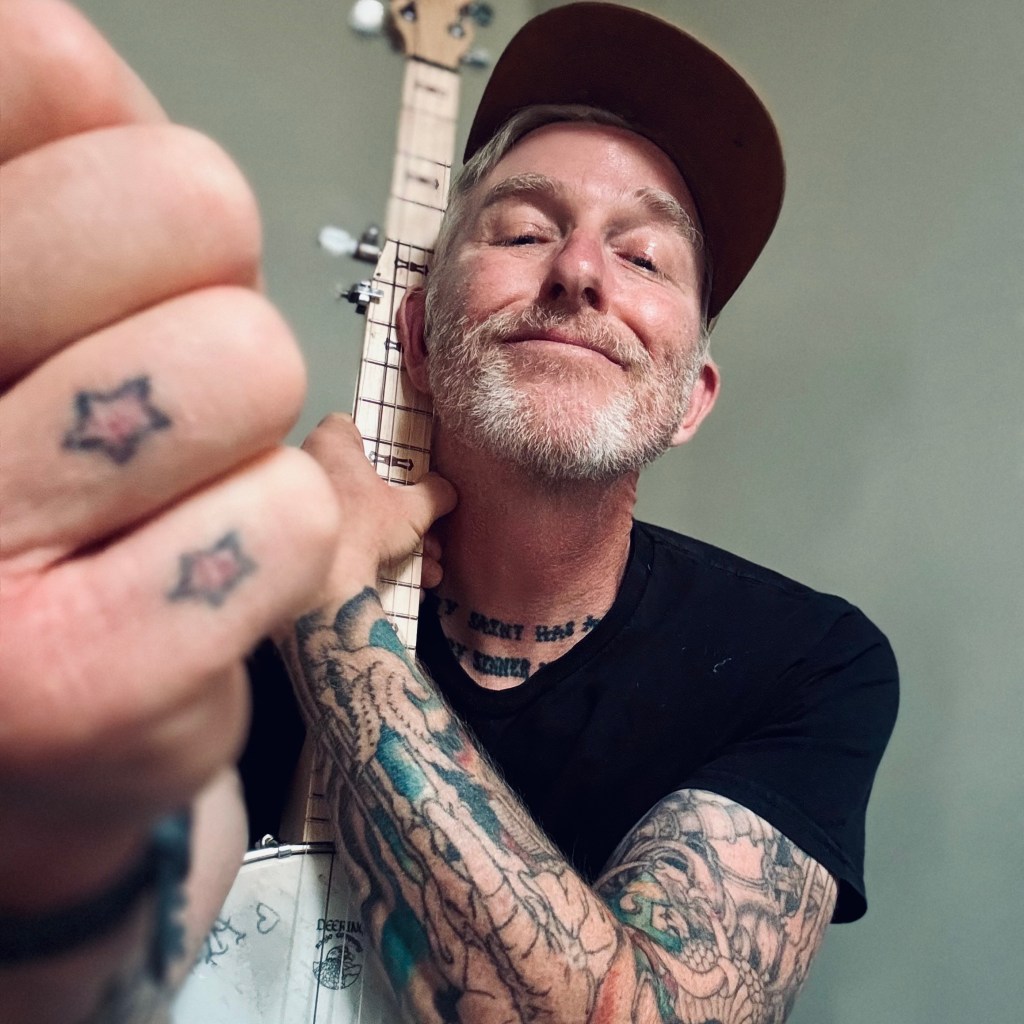
Sassparilla is the Portland-and-Colorado-based band that mixes Americana grit, punk energy, and back-porch soul. Led by Kevin Blackwell, their latest LP, Honey, I’m Using Again (out now) is a haunting, home-recorded collection that explores addiction, loss, and survival with striking honesty. I asked Blackwell ten questions to delve deeper into the serious themes which his music tackles.
THE ARGUS FAR FIVE
How would you describe the sound of Sassparilla?
Gothic Americana.
What are your biggest non-music influences?
The mountains; my dear friends Naima and Chet; writers like William Faulkner, Cormac McCarthy, Carson McCullers, Truman Capote, and Bukowski; random conversations that spark an idea; visual art; nature and wildlife.
If you had to cover any song and put a Sassparilla spin on it, which would you choose?
We just covered ‘What Side Are You On?’ and did exactly that. I rewrote the verses to fit the times but kept the chorus because it’s still so timely. Really, any traditional protest song would be a great fit.
What is your earliest memory of music?
Listening to Rumours by Fleetwood Mac on my dad’s headphones. What a record—I still listen to it today. It was the first album I truly fell in love with. The second would be Taj Mahal’s first record, which I loved just as much.
What does the rest of 2026 have in store for Sassparilla?
We’re going to start playing out again, and we’re aiming to release a single each month. If I’m honest, writing songs and recording them is my favorite part of this gig. I love performing, but creating is the reason I do this.
THE SASSPARILLA FIVE
Your latest album is called Honey, I’m Using Again—quite the confessional title. How important is honesty?
What an ironic question to ask during these times. To me, honesty is everything. With honesty comes integrity, commitment, and love for each other—and we’re severely lacking in those today. Being honest, fearless, and vulnerable… we could use a lot more of those qualities.
You wrote and recorded the album yourself in your basement. Did you ever find it difficult to step away from the process, or were you completely immersed?
Great question. Recording and writing are a passion for me. When I’m creating, I completely immerse myself—obsessively, compulsively. I can lose whole days to a song in the blink of an eye. Lose sleep, forget to eat. When it’s over, there’s almost a feeling of withdrawal.
You got advice from Hillstomp’s John Johnson to use fewer chords. What’s the best song you’ve heard at either extreme—complex versus simple?
I love jazz—my dad is a huge jazz head—so anything in that world. I love the harmonics and movement. My favorite jazz tune is ‘Afro Blue’ as played by John Coltrane.
On the other end, simplicity can be just as difficult to pull off. Then it’s all about feel and groove. Anything in the hill country blues world fits that, but ‘Jumper on the Line’ by R.L. Burnside—wow. That song was a game changer for me. One chord, but so much soul and groove. Genius.
Your 13-year-old son performed drums on the album. What was it like bringing him into the creative process?
Emmett is a prodigy. If I understood and played music like he and his brother do at their age… wow. They have incredible ears, prodigious talent, and taste beyond their years. I trust them musically as much as any of my adult peers.
It was a joy working with them. Grady—Emmett’s brother—isn’t on the record, but both of them deserve production credit. They’d come into the studio nightly, sit on the couch, and give candid feedback on changes I made. It was incredibly valuable.
The title track is quite a jaunty number considering the subject matter. How did you decide on that contrast?
Another great question. I wanted the song to feel like a call-and-response chant because I think this is a shared experience. The title is meant to be metaphorical—for any vice, behavioral or otherwise, from the benign to the catastrophic. I imagined the catharsis of a crowd yelling it together in a live setting.
Thank you so much for taking the time to ask these questions and listen to the record. It means a lot. I really appreciate you supporting smaller artists and giving them space to be creative and heard.
Thank you, Kevin! It’s been a pleasure.
Join our (free) mailing list to support the site and never miss an article again!


Leave a Reply