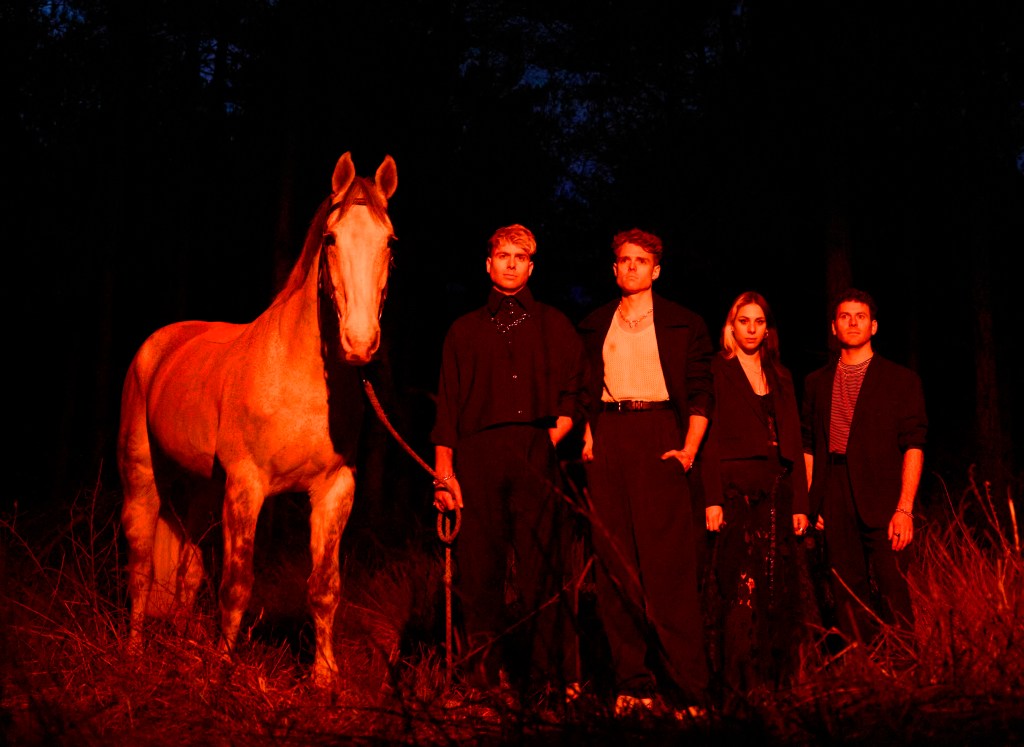
Formed in 2020, Daytime TV are a four-piece band whose members bring together English, Scottish and Italian backgrounds. Since then, the band have performed with artists including Circa Waves and Two Door Cinema Club, as well as making appearances at BST Hyde Park and Mad Cool Festival.
Having signed to Marshall Records in 2026, Daytime TV are entering a new chapter with their second album, Rodeo, due for release on 19 February 2027. In a departure from their earlier alternative-rock sound, the record embraces a more experimental, electronic direction. I caught up with lead vocalist Will Irvine and guitarist John Caddick to discuss finding the band’s identity and learning how to leave any ‘what ifs’ behind.
You’ve previously mentioned that you’re not trying to box Daytime TV into a fixed genre, such as pop or rock. How would you characterise your music without using a genre?
Will: I’d go with spicy margarita.
John: Unhinged.
Will: Unhinged. I like that.
John: Feral, I think. A lot of energy.
Will: Feral is fun. Genres are one of those things I love and hate because you have to lean into something to describe what you’re doing. At the same time, they can pigeonhole bands quite aggressively.
John: When people ask, I usually say about seven genres.
Will: Alternative, acid, funk, pop, jazz. We’re trying to push the boundaries of what a guitar band can be. It’s a tagline I really like because people perceive us as a guitar band, whether that’s rock or pop or whatever, but we’re trying to find ways to make that exciting.
Would you say that’s changed over the years? Do you feel you’ve found your sound now, or are you still looking to change?
Will: I think so. When we started out, as is probably the case with most bands, you try to please people a little bit. You think about what they might want to hear, and you tend to stick quite closely to your influences when you’re still finding your feet. But I think we’ve become braver and bolder, and more willing to push for something unique.
John: We’ve become braver with our instrumentation and the elements we bring in. We’ve incorporated far more electronic elements as we’ve learned more over time. When we were writing the album, we weren’t necessarily listening to loads of music, either. We weren’t going into the studio thinking, let’s write something with this kind of vibe. We were coming at it from a completely clean slate, which helped.
Will: But it made things difficult. I remember our producer, Pete Hutchings, saying that it’s quite handy if a band can say ‘we want to sound like this’. We weren’t giving him any of that. He was thinking, ‘Right, this is a real puzzle. What is it going to sound like?’ It slowly evolved as we added things to each track.
John: I think we’ve definitely found the thing we’re looking for, which is a sound. If you put on a big Spotify playlist of loads of artists, I think Daytime TV would stick out. People would immediately recognise us within the first few seconds.
Your band members come from quite different backgrounds and bring a range of musical influences to the table. How does this shape the way you make music together and push the boundaries as a band?
John: You can hear the intense sporting rivalry as a consistent undercurrent in the songs.
Will: Scottish tears and anger. No, but Naomi’s Italian swagger is definitely a big part of her persona. She brings such a cool vibe to the table. It’s a great question, we’ve never really thought about how our backgrounds influence the music, though.
John: I think it shows up in our musical upbringings more than anything else. We each bring quite different musical influences to the band.
Will: It’s not like we’re a band where we’re all from Manchester, have had the same experiences and want to sound the same.
John: We’re into quite different, disparate music, which is cool.
Will: I think having someone who goes entirely on feel alongside someone who is academically trained and has a great understanding of music is a combination that can take you anywhere. If you were relying entirely on feel, you might end up with something that has a great story but doesn’t quite push the boundaries musically. On the other hand, if you had something that was entirely about technical training, it might end up being difficult to access.
John: We both come up with things the other would never have thought of. We’ll be sitting there struggling for something, and out of thin air, one of us will come up with something completely left-field.
Will: Apart from the time we were writing ‘Pause’. John had a guitar riff, and when he played it, I thought it sounded a bit like my idea. Then I played mine, which was in the same key and at the same tempo. His idea was the chorus and mine was the verse, so we put them together and the song was finished.
John: It was the easiest writing day of all time.
Moving on to your Rodeo album, are there any particular favourites among the songs you’ve released so far?
John: I love ‘Sun’ because of its light, uplifting energy. Playing it live, it’s always the one you can boogie to the most.
Will: Boogie time is important.
John: Boogie time is important to me.
Will: That should be the headline. There’s a song called ‘Power’ and another called ‘Rise’, both of which are still unreleased. Thematically, they’re the crux of what the record is about. They still give me proper goosebumps and make me feel a lot when I listen to them. I’m really happy with them and can’t wait for people to hear them.
John, you mentioned that ‘Sun’ has a happier feel to it. Was the process of writing it different from the other tracks?
John: I think we approached the whole album with a sense of optimism. The writing days usually start with you capturing the mood of the day, but I think the whole album has an undercurrent of optimism. It’s not necessarily euphoric energy, but it’s definitely positive.
Will: Even the darker songs have an almost ‘after the storm’ energy. It’s about what comes next, so I suppose it is positive. ‘Sun’ and ‘Meditate’ are in the same camp. They were really fun and light to write. Everyone was smiling and laughing, and I didn’t need to dig quite so deep into the well of lyrics.
With ‘Sun’, the idea was about longing for a safe place in your head. We then made that physical through the image of an island in the sun, somewhere you might go in your mind when things aren’t great. As soon as we had that line, the song was almost finished. It was just about creating this huge groove, which was fun.
A lot of the songs on the album have single-word titles. Is there a particular reason for that? Do you find you can encapsulate a song quite easily in one word?
Will: The genuine reason is that a lot of them started as working titles. We’d say: ‘This one’s called “Sun” and ‘This one’s called “Power”.’ But when we looked at them on paper, we realised those were the words that encapsulated the tracks.
John: It’s quite hard to change from there, isn’t it?
Will: I quite like it. A couple of them, like ‘Love Isn’t That Simple’, are different, but that was always going to be the title because it’s a lyric. If you can condense something into its purest form and find one word that captures the song, then I’d always go for that.
Why couldn’t you condense ‘Love Isn’t That Simple’ into one word?
Will: Because love isn’t that simple. That’s probably genuinely it.
John: It’s perhaps the most raw song on the album.
Will: The title actually came from when I was out on a run. There was a busker with a one-string guitar who was mumbling things. As I ran past him, he mumbled: ‘Love isn’t that simple’. I didn’t think much of it at first.
Then, as I kept running, I thought, that’s a great lyric. So I basically stole his idea, but I always credit him in interviews. By the end of the run, I’d written the rest of the chorus in my head. It made so much sense because that’s exactly what the song ended up being about, discovering that love isn’t that simple through experiencing how difficult it can be. It’s weird how things work out like that.
Will, I understand you had a health scare a few years ago. How has that experience influenced your approach to making music, particularly with songs such as ‘Creatures’ on Rodeo?
Will: I think it’s definitely affected how the whole band operates. There’s a freedom and boldness that we carry now in everything we do, whether that’s a live show, a writing session or being in the studio. Having gone through that experience, it’s almost like we’re getting a free shot at it. There was a point when we thought we might never be a band again because of the health issues.
All of this is an opportunity to do the things we’d never want to leave on the table. What if we approached a song like this? In the past, perhaps we wouldn’t have been bold enough to go down that road and find out what was at the end of it.
It’s definitely affected me personally in terms of being brave with songwriting and sound decisions. As a band, we’re not worried about what people might think of our music. When you first start out, you’re thinking: ‘We really hope Radio 1 like our music.’ I think the best art and music are made by people who don’t worry about those things and just make something that’s true to them.
John: I think it focuses your vision and makes you realise what is important and what truly matters. Having that perspective as a band is very freeing. The simple act of getting to play music together for people who like that music is such a powerful thing. To almost have it taken away and then get it back is an amazing feeling.
Will: A rebirth, if you will.
Do you think that experience contributed to the more positive outlook on Rodeo, and did it make the songwriting process more cathartic for the band?
Will: Massively. It’s just real experiences that happened and that we then wrote about. We’ve been in enough writing sessions to know that sometimes songs start from a perspective that isn’t based on lived experience. It’s more like, ‘Let’s write a song that could sound like this.’ We came into this record with so much real experience that we desperately wanted to get down on the page.
That sets you off on a different path. You don’t feel like you’re writing a song; you feel like you’re releasing something from within. It feels essential.
John: Like self-therapy.
Will: Exactly. It feels essential to say these things. Getting to spend the time we did making this record and dressing up these ideas in a certain way was amazing. Having that freedom was partly a result of those experiences.
Was there a particular moment in the studio when you felt that sense of creative freedom come together?
John: Everyone’s personality and the way they approach their instrument or their role in the band really shines through in the recording. In the studio, everyone had their moment where they’d do a little random thing that made it onto the record. That’s part of the beauty of the whole thing.
Will: We were talking earlier about ‘Rise’. Gaz did a backing vocal for it, and he was singing in the way he would normally approach a backing vocal. But Pete, the producer, was trying to get something more out of him.
I was just listening, and he did this take where you could hear that all his inhibitions had disappeared for a split second. It gave me instant goosebumps. I was crying, and the whole energy in the room changed. It was like: ‘Oh my God, we’ve just captured something truly special.’ It was a man shedding his fear and anxiety around performing. It was amazing to witness.
There were a bunch of moments like that for everyone during the recording, and they’re all in the tracks. They’re baked into these songs. I love that about the record, and you can hear it if you know it’s there.
Join our (free) mailing list to support the site and never miss an article again!


Leave a Reply