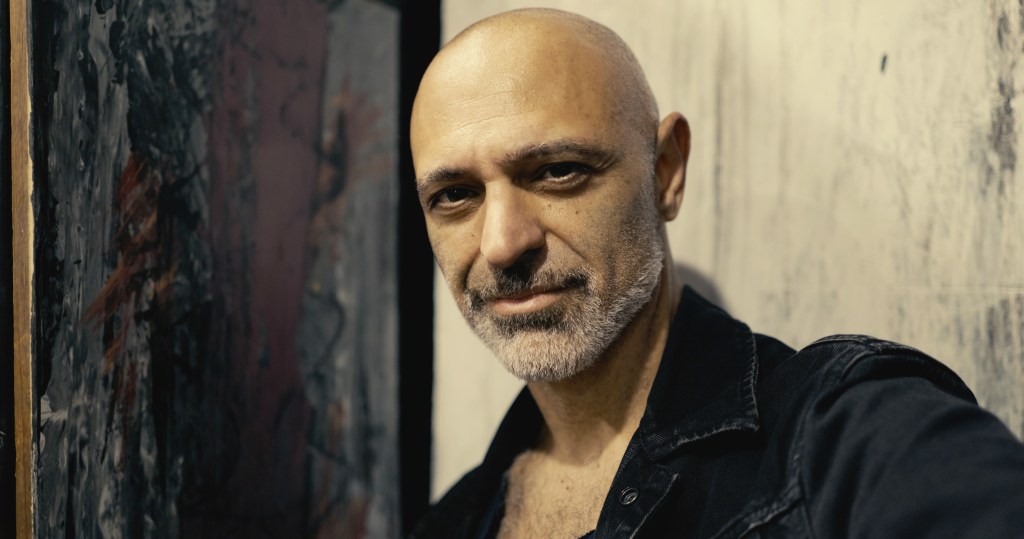
I am incredibly honoured to present to you lot, my lovely readership, the exclusive premiere of Reza Safinia’s latest single, ‘Watching From The Wings’.
Reza Safinia is a London-raised, Los Angeles-based multi-instrumentalist, composer, and producer whose work moves fluidly between electronic music, classical composition, and film scoring. Over the course of his career, he has collaborated with artists ranging from Dr. Dre and Britney Spears to Kylie Minogue, while also touring with Destiny’s Child and composing for film and television, including the HBO Max/Netflix series Warrior.
‘Watching From The Wings’ is the second single from Safinia’s upcoming double album, 1/∞, out this August.
Watch the video below, and scroll down to read our ’10 Questions With…’ Reza Safinia!
10 QUESTIONS WITH REZA SAFINIA
THE ARGUS FAR FIVE:
How would you describe the sound of Reza Safinia?
A modern Depeche Mode meets Bowie meets Electronic.
What are your biggest non-music influences?
Bruce Lee and Muhammad Ali .
If you had to cover any song and put a Reza Safinia spin on it, which would you choose?
Cocteau Twins’ ‘Cherry-Coloured Funk’.
What is your earliest memory of music?
My aunt giving me a Barry White cassette. It had a green case; I was obsessed with this song ‘The Trouble With Me’.
What does the rest of 2026 have in store for Reza Safinia?
Releasing the 1/∞ album and growing the 1/∞ podcast with incredible guests opening up about their spiritual process in accessing creativity.
THE REZA SAFINIA FIVE
As mentioned above, your latest single, ‘Watching From The Wings’, is about the 2026 Iran War and the survivor’s guilt you feel. How has your Iranian heritage inspired you in your career?
In many subtle ways. Iranian culture is very sensory, the language is poetic, the interactions between people can be warm and also dramatic, the food, the art and music are sumptuous, all of that plays into the way I feel. There’s an inbuilt spiritual depth in the culture that doesn’t need to be called out as spiritual, it’s just the baseline, and I feel that’s in my artistic sensibility in the same way. I don’t use Iranian scales so much in my music, I don’t sound like I’m making Iranian music, but there’s a subtle hint of the vibe in me.
Your last single, ‘I Feel U’, is about seeking connection in an increasingly fractured and isolated world — in particular, a world seen through the screen of a device. How do you think this has impacted live performances, a place of real musical connection in which phones and filming are ever-present?
Great question. I went to UNVRS, this mega club in Ibiza. It was packed and nobody was dancing, people were just filming this visual spectacle that eclipsed the music with their phones. It looked so dystopian, like an army of 10,000 saluting their dictator with their phones.
You’ve worked with artists as big as Britney Spears and Dr Dre, and have toured with Destiny’s Child. What surprised you most about these artists?
All of them were great people, warm, friendly, humble. Also all of them work extremely hard.
You have an upcoming double album, 1/∞, which is split into four elemental acts—Fire, Water, Earth, and Air. How did you decide on this structure, and what effect do you think it has produced?
The structure was decided by itself! When you sequence vinyl, you have to max out at 20 minutes a side and have the last song on each side be a calmer, less bass-heavy track… when I fit the tracks in an order that fit these two criteria I noticed all the sings on side A were fire vibes, all the songs on side B made water references, all side C air, and side D earth. It just happened that way!
Your music is influenced by both electronic ambient and Romantic-era classical music. How do you synthesise these disparate genres, the analog and the digital?
I don’t think they are disparate. If they had cracked everlasting life a few hundred years ago, and Beethoven was 300 years old day, he’d be making music with analog synths infused into his symphonies! Joking aside, the mood is similar whether using acoustic instruments or synths, they’re just the tools that can be rearranged to fit whatever the experiment requires… it’s a bit like a painter deciding to use acrylics sometimes, and oil others, or sometimes painting over a printed photograph…
Join our (free) mailing list to support the site and never miss an article again!


Leave a comment