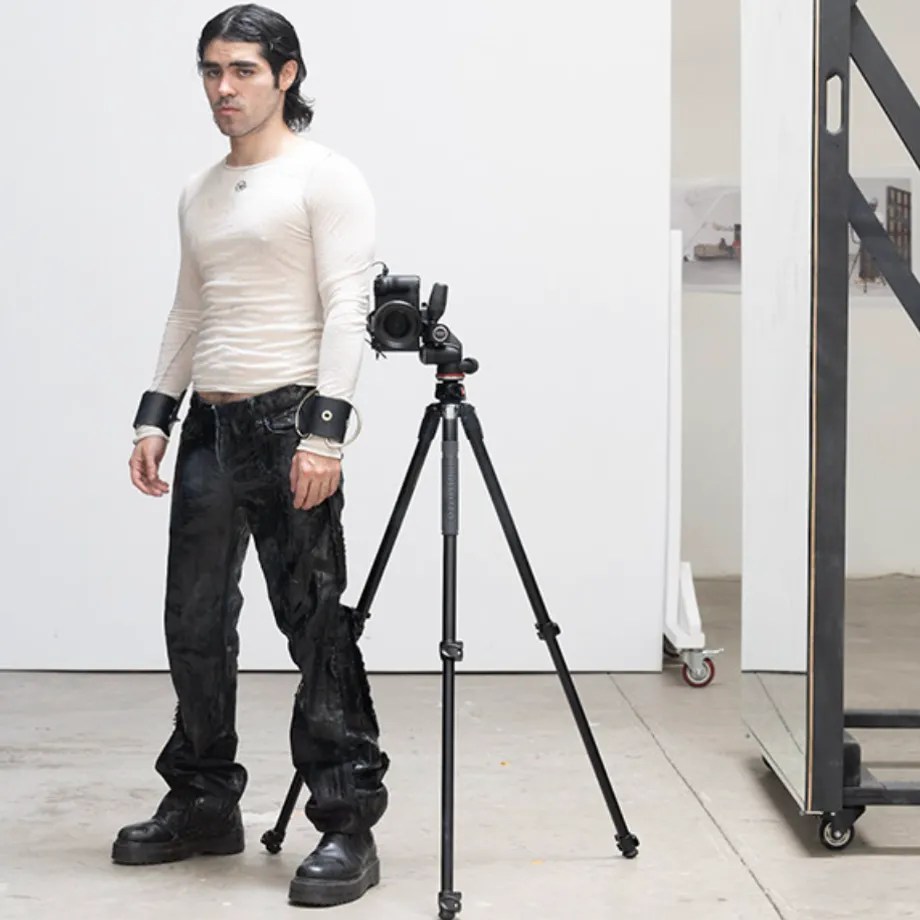
EVRO is an electronic pop/post-punk project created by LA-based musician Matiss Evreoux, inspired by both contemporary reality and rave culture. A self-proclaimed ‘Hyperpop Morrissey’, EVRO’s latest EP, Romance In Saturn’s Return (out now), adds an indie rock edge to his electronic sound, contemplating themes of love during times of change. I asked EVRO ten questions to unveil the man behind the leather mask.
THE ARGUS FAR FIVE
How would you describe the sound of EVRO?
The sound of EVRO is my perspective on the human experience, one that lives in a non-dual space where nothing is purely good or bad, but exists somewhere in between. It’s always evolving, but at its core, it’s my interpretation of alternative music I love, shaped in a way that feels contemporary.
What are your biggest non-music influences?
Film is my biggest influence. When I was 10, two movies really shaped me: Babel, especially Rinko Kikuchi’s Tokyo storyline—and Planet Terror from the Grindhouse double feature. That sense of immersion, intimacy, and tension made me want to create music that could live inside scenes like that.
I’ve always been drawn to filmmakers like Pedro Almodóvar, Alejandro Jodorowsky, Alfred Hitchcock, Quentin Tarantino, Alejandro González Iñárritu, Alfonso Cuarón, and Gregg Araki. They create my favorite immersive fantasies.
I started making music because I wanted to score the emotional worlds I was seeing on screen, to translate that feeling into sound.
If you had to cover any song and put an EVRO spin on it, which would you choose?
I’d probably cover ‘Souvenir’ by Orchestral Manoeuvres in the Dark. There’s something about its emotional restraint and atmosphere that feels really aligned with my world.
I’ve also thought about something like ‘Human Sadness’ by The Voidz (but I guess it’s too similar to my sound). ‘Souvenir’ feels like the most natural fit for a reinterpretation.
What is your earliest memory of music?
My earliest memory of music is being around three or four years old and seeing ‘Chop Suey!’ by System of a Down on MTV.
What does the rest of 2026 have in store for EVRO?
Right now I’m focused on playing live and fully stepping into this EP, letting it exist in the real world and connecting through performance. I’m also working on an album, but I’m not putting a timeline on it. It’ll be ready when it’s ready.
THE EVRO FIVE
What about rave culture has inspired your music?
I used to go to raves almost every weekend in LA and New York, and what stayed with me is how tribal it feels. Techno drums, the speed, the repetition, it puts people into a trance where they can purge whatever they’re carrying and connect through the body.
There’s something really powerful about that shared release on the dance floor, like a modern form of ritual. It feels deeply contemporary, but also ancient at the same time, like our version of dancing around a fire. That tension between the primal and the futuristic really inspires me.
Your website says that your sonic identity can be described as ‘hyperpop Morrissey’. Could you explain this?
My project Everyone leans into a hyperpop space, but emotionally, I’ve always written from a more introspective, melancholic place. There’s a certain vulnerability in my melodies and delivery that people have compared to Morrissey.
So ‘hyperpop Morrissey’ became a simple way to describe that contrast, highly digital, contemporary production paired with something more emotional and inward.
In pictures of your performances, you’re wearing a black leather mask. Why?
There was a moment where I didn’t want my face to be part of the experience. We’re constantly exposed to faces, especially on platforms like Instagram and TikTok, and I wanted to create something where people could project themselves into the character instead of seeing me as separate from them.
The mask became a way to remove identity and make the experience more universal.
At the same time, there’s a practical side, platforms don’t always respond well to that kind of anonymity, so it became part of a larger experiment. I’ve always been inspired by artists like Orville Peck or Daft Punk who fully commit to that kind of world-building, but right now I’m in a phase where I’m showing my face again.
What’s the meaning behind your latest EP’s title, Romance In Saturn’s Return?
Romance In Saturn’s Return comes from going through that phase in real time. A Saturn return is about being tested, everything you think is stable starts revealing itself in a different way, especially in relationships.
The EP explores what it means to be romantically involved during that kind of transformation, where illusions fall away and you’re forced to confront things as they are.
It’s about moving through that tension, even when it’s painful, and coming out with a deeper sense of clarity.
The EP has moved your sound more towards an indie rock/dance direction. Why did you make this shift, and which records inspired it?
I think as humans we move through different phases, and as an artist I just channel whatever feels most natural in that moment. This shift toward indie rock and dance wasn’t calculated; it was just where I was creatively and emotionally.
I was drawn to the sensibilities of guitar-driven music in a deeper way, and that started shaping the sound. It’s not one specific lane either, each track pulls from a different space within indie. Some lean more British Invasion, some feel closer to early 2010s indie dance, and others have more of an alternative or even grunge edge.
I was inspired by artists like The Zombies, The Animals, The Killers, Julian Casablancas and Phoenix, but it’s really just my interpretation of different types of alternative music I’ve always loved, filtered through where I am now.
Join our (free) mailing list to support the site and never miss an article again!


Leave a Reply