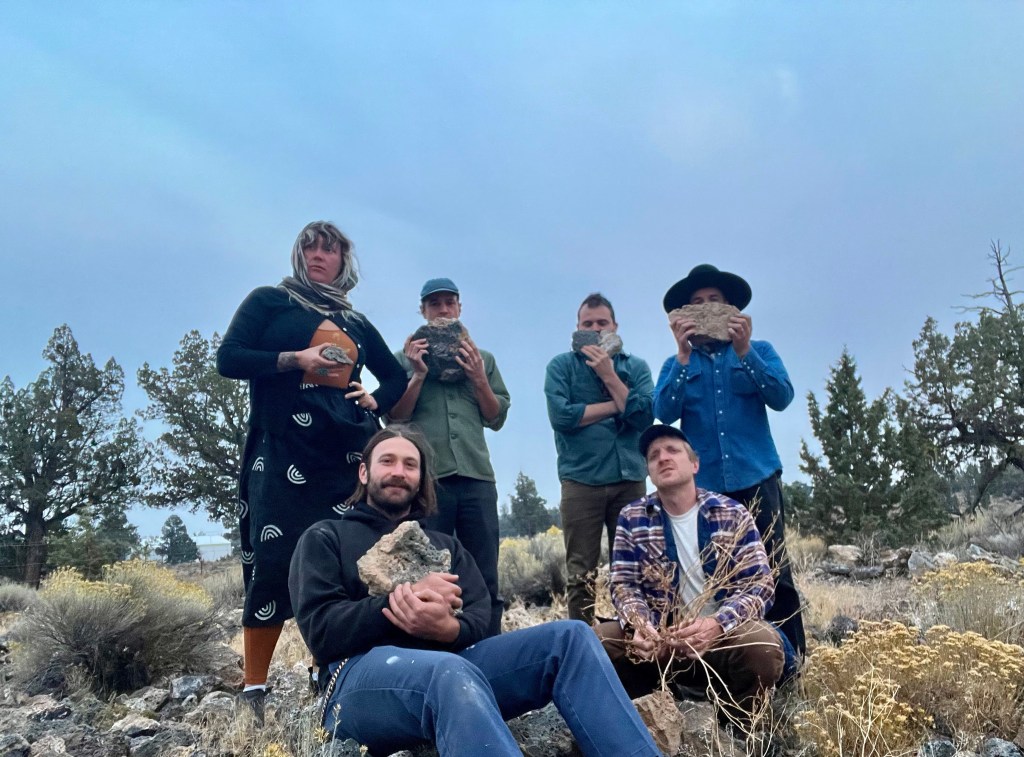
Abronia are a six-piece, genre-blending band from Portland. Desert noir, Eastern drone, avant-jazz – whatever you want, they’ve got it. Their latest LP, Shapes Unravel, came out last Friday, a review of which you can read here. I asked guitarist Eric Crispo ten questions to dig deeper into the rich sonics of Abronia .
THE ARGUS FAR FIVE
How would you describe the sound of Abronia?
I try not to. That kind of question that often fills me with dread. I’ve never really come up with a good answer for it, so I usually just tell people to listen to it.
It’s so easy to listen to music nowadays. Why do you have to explain it? You know what I mean? Just give them the link. I just give them the link and say, “if you’re curious here. If you’re not curious, don’t listen to it.”
What is your biggest non-musical influence?
I’d say landscapes and natural landscapes.
If you had to cover any song and put an Abronia spin on it, which would you choose?
Any song? Jeez, I don’t know. I don’t really do covers in general. I don’t know if I’ve done one since high school, so it’s a hard question to answer for me.
I think a 60s girl group song would be fun, like a Ronettes song or something. That’d be great.
What is your earliest memory of music?
There was like a cinderblock wall between my house and my neighbour’s house. I remember sitting up there with a little Fisher Price cassette player and I think it had a Michael Jackson cassette.
I was playing it; it had a little speaker on it. I must have been five or so. It’s one of my earliest real memories of music.
We got into a brief conversation about hometowns. I asked Eric if this was in Portland, where Abronia is based, but he says that the memory comes from Southern California.
I was born in Los Angeles, but my family moved to a small town in North Carolina when I was eight years old. None of [Abronia] are actually grew up in Portland, but I’ve been here a long time – since the early 2000s, besides all the traveling I’ve done.
We may have exceeded the ten questions quota here, as I went on to ask, “Would you class yourself more as a North Carolinian or a South Californian?”
Probably more North Carolinian because we moved there when I was eight years old and I went to high school there. Formative years were spent there, where I got into music. I grew up close to Chapel Hill and, in the 90s, there were a lot of bands coming through there all the time and bands from there that were notable. That shaped my early, early musical life.
When was the first band you joined?
First band? When I was like 14, we got a guitar strung, this acoustic guitar we had around the house for a long time. My mom always had it. I think a boyfriend gave it to her in the 70s. It had three strings while I was growing up. It was just in a case in the corner.
Sometimes I’d get it out and mess with it, but I didn’t know what I was doing. When I got into rock and roll and was like, “I want to play guitar.” I remember my mom saying, “Well, we’ll just get that guitar strung, and you can learn on it.” Bummer. I wanted electric guitar, but we got that guitar strung.
Then, it was the summer when I was 14, I was just hanging out board with my friends. And one kid was like, “I want to play drums,” so we got a popcorn tin. He played with spoons.
I could only play single note things at the time, one note at a time, but I’d make up these little melodies. And then our other friend had a trumpet, because he was in the school band.
We went out around the neighbourhood one summer day and started playing on the street corner of our suburb. Just to goof off, we’d make up these little songs and we’d go play them on the street corner.
I think we only did it one day in the summer, but those guys, I actually ended up starting a real band with when I got my electric guitar – the guy who played the popcorn tin got his drum set the same day I got my first electric guitar. So, I went to his house and started jamming when we were 14. And then the guy playing trumpet eventually got a bass and he was our bass player. We had a band through high school, changed bass players, but I’ve pretty much constantly been in bands since then.
Imagine a no-sidewalk, suburban neighbourhood in the summer with no city to speak of, basically one-acre lots of houses, you know what I mean? Just grass, playing in the grass. Some kids on their bike came by. One of them said, hey, if you played a Nirvana song, I’ll give you a dollar.
The only Nirvana I could play was, it wasn’t even a Nirvana song, but it was from their MTV Unplugged. I could play ‘Plateau’, just the intro, the ‘dung, dung, dung, dung, dung, dung, dung’. And I played that, and the kid gave us a dollar.
Back to the ten.
What does 2026 have in store for Abronia?
We’re going to be doing a lot of shows. At the end of this month, we’re playing Portland, Seattle and Bellingham with this band, Jackie-O Motherfucker. And we’re going down to California in March.
We’re going to the Midwest and the East Coast of the US for the first time this summer, so we’re booking that summer tour right now. We have some shows confirmed already.
We’ll play Chicago and New York and Philadelphia and a bunch of other towns.
I asked if Eric had ever played on the East Coast himself.
Oh, I played there in other bands, but yeah, Abronia’s never played there. We’ve toured Europe and the UK, and we’ve toured the Western US, but we’ve never made it to the East Coast of the US yet, which is somehow harder than going to Europe in a way. It’s so far.
Somehow, Birmingham came up.
Oh, yeah, we played Supersonic Fest. You know that festival? That’s why we did the tour, I think, because they invited us to play that.
We played a few shows in the UK. Actually, I feel like our London show was kind of the wrong venue. In Manchester was also the wrong venue.
Was that in terms of size?
We weren’t playing with the right bands in the right place. Sometimes that happens, when you’re playing a place, especially the first time.
Some promoter came to our show in London was like, “I want to book you guys. You should have contacted me.” And yeah, he does Baba Yaga’s Hut in London. He’s the guy we should have contacted, but we had a booking agent, and we didn’t know. But it was cool.
We played our probably our best UK shows in Scotland at this little town called Dumfries. We had a night off after something fell through, and it was, I think, the only UK show that I booked. But this guy runs a record store there, and said, “I saw you have a night off. I can book a show in Dumfries. How much do you need to play?”
And I was like, “£350.” And he’s like, “Done. Great.” It was on a Monday night.
He owns the one record store in that town, and he knows everyone who’s into music. He got a local band on, and everybody bought a record. He also bought a ton more records from us after the show, because he said there were a lot of people who couldn’t come that wanted a record. It’s a legendary show in my mind now.
Bristol was cool, too. It was in a bowling alley place that does shows.
I’d never been around the UK. I’d been to London once. I’d never played the UK before that tour, but I liked it. I’d heard bad things from other American bands who’ve toured Europe and the UK. They’re like, “Oh, yeah, you know, people aren’t as excited in the UK, you’re not going to get paid as much, you know, people aren’t going to come out.”
I still liked playing in there, mostly. And I like to see the old towns. Our label guy is there, Dave from Cardinal Fuzz, so we got to meet him for the first time. He came to our Manchester show. It was really awesome to meet him and hang out.
There’s a big difference between America and the UK: it seems as there’s a lot of old people who come out to shows there. They’ll tell you about all the bands they saw in the 70s. They’re really excited to buy your record. It’s like the people don’t stop going to shows there.
Though I suppose it’s a bummer that if your fans are all in their 70s, if your band keeps going, you’re going to lose all those fans.
THE ABRONIA FIVE
How come Abronia chose to go for just the one massive drum?
That was that was my idea. The idea just came to me, and I had to see it through. I was playing with drummers a lot for my solo project called Ghost To Falco. I was always trying to get drummers to play less. Every drummer was too busy when they started playing with me and I had train them out of playing so much. So, I thought if I gave someone just one drum, it’d be hard to overplay.
I had a vision for what the music was, and I thought that the one drum would keep it in that world. When I actually started shopping for them and I found the right mallet to hit it with, it was just like, “oh, oh, yeah.” It was just so big and powerful.
Part of it is if you want to make something unique, you use different tools. It’s a shortcut to uniqueness.
How did the band settle on the cover art style?
The first album, we actually hired an artist to do it, someone Keelin knew, and that was cool, but we wanted something different for the second album. We were trying to come up with some art cues or someone to do it, and we couldn’t decide on anyone. It was just months of back and forth, trying to come to a consensus on what we wanted.
We’re a pretty democratic band, everyone has a say, so we decided to sit down with some old magazines, we all had collections, and see what we can make together. We’ll see how that turns out.
That was The Whole Of Each Eye, the first collage cover that we did. We’ve talked about trying to do different things since, different approaches to the album art, but we always come to the impasse of someone likes one artist and someone else doesn’t. So, well, we’ve got to make it together.
We all sit down around Keelin’s table with a bunch of magazines, we cut things out, and we put them together. We get the basis going on that, and James Shaver and the band will take it and lay it out in the digital realm.
If you could add any instrument to the band, which would you choose?
I don’t know. I definitely don’t want another member in Abronia. I think six people’s enough.
There were songs on this album we added strings to, we added trumpet. I would almost say it’d be cool to have a horn section sometimes, like a Motown-style horn section would be cool in Abronia. But I also don’t care enough to really make that happen most of the time.
I think it’s satisfying enough to compose for the six elements we have. I like to keep it as a live band that’s focused on the live show. One of our fans at a show once said, “I mean this in the best way, but your live shows sound so much like your records.” And my counter to that was, “No, I think our records sound like our live show.” That’s how I think of it.
Is it another sort of democratic process on how the songs are titled?
Yeah, somewhat. I think Keelan gets last say on that because she’s the one singing the words, so she has veto power on the song titles. Some people will shoot down song titles for sure. Album titles are always the hardest for us to come up with. That’s the hardest one.
Shapes Unravel used to be a song title, actually, and then we changed the song title to use it as album title. We were having such a hard time coming up with an album title. It’s always hard.
I asked if any of Eric’s darlings had been left on the cutting rooms floor.
No, I can’t think of any off the top of my head. I have a list, but usually, if I liked them, there’s nothing I’m saving that I haven’t thrown out to the band already. Because all the ones I liked have been shot down, I’m sure.
They’re there for use for something else, maybe, but not this band. Unless I bring it up again, and they all forget that they didn’t like it last time, which is possible. I think that kind of thing has happened in this band.The different day, somehow that sounds better today.
I’ve definitely done that with this band sometimes. Sometimes there’s parts it’s like, “Oh, I can’t introduce that riff right now because it’s a little bit like this other riff that got shot down recently.” I’ve got to wait like a year and then I’ll bring it in. The barometric pressure has to change or something.
What is your favourite song from Shapes Unravel?
They’re like children – it’s hard to pick a favourite. I tend to start to like the ones I haven’t thought about enough, sometimes the newest ones.
I think maybe ‘Petals and Sand’ right now, because it’s the newest song for the record, so it’s still the one I’m trying to unearth a little bit.
The older ones I’m more familiar with. They’re less exciting to me, even though I like them all. But I really feel good about all of the songs on this one.
Do you find that when you play songs live, when you listen back to them, is that still part of the process for you?
I feel like a little more gets revealed every time you play a song live and there are little parts you start changing, just adapting slightly.
They’re alive. When you’re playing the songs, like touring or whatever, it’s like they’re slightly evolving. Someone might not notice who’s not in the band, but there are things like, “oh, that part, we’re really biting into that part in a way we didn’t do on the record.”
Something slight might change and get more exciting. Certain things might get a little more improvisational. But it’s fun, because in the age of recording, it’s easy to think of a song as done, but I don’t think before recorded technology, songs were ever really done. They probably just kept evolving forever and then whoever you pass them down to would evolve them further. Even with written musical notation, it’s like everybody who sees that is going to play it a little differently.
The recordings have this weird finality that seems almost unnatural to think about, a final version of some piece of music. It’s not really what it’s about.
In a certain way, it’s almost like a museum artifact, one of those stuffed mammoths you see on display. It’s still interesting to look at, but it’s perhaps unseemly, slightly uncanny.
Exactly, yeah. I think that’s a good metaphor.
Pop your email below to support the site and never miss an article again!
 Argus Far
Leave a comment