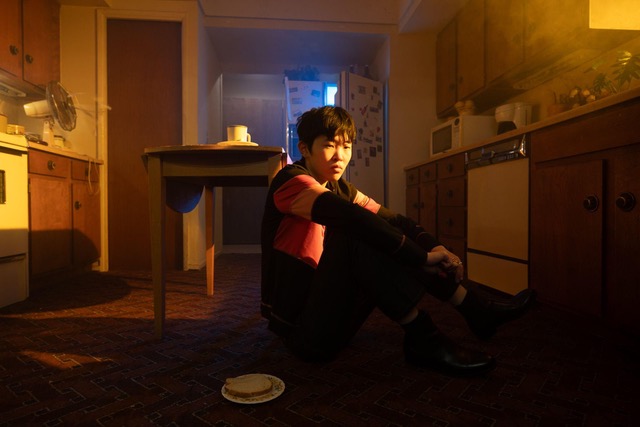
Baek Hwong, aka NoSo, is a Korean-American singer-songwriter known for their intricate guitar-playing, poignant lyrics and reverbed production. Hwong is currently performing across Europe after the release of their sophomore effort, When Are You Leaving?, closing the tour in the UK. I had the pleasure of chatting to Hwong, touching on Hong Kong film, Karen O, and the transformative power of live music.
You’re going to be on a UK tour next month. How did you find playing here in the past?
I love playing in the UK. I feel like the audiences are always really respectful. I’ve only ever played thus far in headline shows in London and Manchester, and I opened for Khruangbin in Halifax and Gunnersbury Park back in August of last year. I always have the best time, and I’m really excited to be back.
Do you enjoy travelling around then on tour?
I’ve been able to visit so many different parts of the world that I otherwise wouldn’t have even known of because of this endeavour and so yeah, I really enjoy it. I think I’ve had some really precious memories on tour and especially on international ones.
Do you have any places that have a particularly special place in your heart? And don’t feel like you have to say London or Manchester.
I mean honestly, my first London show was at a venue – essentially, at the bar underneath – and the room was just so jam-packed with people. That was the first time I felt like there was an enthusiasm for my music, so London and the UK as a whole has always been really special to me because of that memory. I’m really excited to be back.
With your lyrics, perception seems to be quite an important theme that runs throughout, either not being seen or being seen too much. How does that play into performing live, up on a stage with all eyes on you?
For me, a lot of people who go to my shows have had similar experiences. At my last London show, this guy told me that the song ‘Parasites’ really touched him when he was in a really difficult place in his life. He’s like, “I’m just some cis straight dude but that song gave me hope.” That song is about gender-affirming top surgery, so I always thought it was so niche and specific and only certain people could relate to it, but I feel there’s some overlying themes in my music that creates an environment where I feel very seen by the people who go to the shows, and I think performing has always been a way for me to express myself because I’m pretty introverted and shy. It’s always been a really good thing.
I suppose with that comes authenticity. Do you find that to be a particularly important part of being a performer, being authentic to yourself and putting that authentic self to the fore?
For a long time when I first started making music, I would question whether I was being perhaps too honest about some of the experiences I had. I feared that I was too niche as a person and therefore it wouldn’t translate to my music, but some of the lyrics I’ve written about these experiences I had as a child, where I felt like no one else has ever felt that way, resonated, especially in these kinds of homogenous environments.
There have been listeners who said those specific lines have really resonated with them and were relatable. My philosophy since I’ve started, because of those reactions, has always been to be true and honest to the experiences that I’ve had.
Is there anything in particular that informed your work, in terms of non-music art?
For this particular record, Wong Kar-wai’s visual aesthetics inspired the album cover and the moodiness of the record. I like to take a lot of inspiration from things outside of music. I think it helps me stay refreshed and excited about it.
I saw an interview in which mentioned sometimes you feel stuck in a rut with your songwriting, and you feel like you need something to refresh it – I suppose in this case it’s film. You also mentioned that you were learning piano to revitalise, which comes through on ‘My Fault My Fault’, a brilliant, lo-fi piece with an Alt-J vibe, like a stripped-back track from The Dreamer. Are there any more instruments that you’re working on?
I grew up playing piano by ear and I never formally learned how to read music. Even though I went to music school, I wasn’t paying attention because I was a rebellious, being an annoying 18-year-old, and so I’ve never really been able to read sheet music. Within the last few years, I’ve been trying to learn piano in a way that’s painstaking for anyone who overhears because it takes me so long, but it’s really good for me to rewire my brain that way, always having played music by ear.
Piano has opened up a lot of different inspirations for me with writing, and I’ve been learning bass by ear. That’s been helpful for recording and also for the way I play guitar.
During your Tiny Desk Concert, you mentioned that you’ve healed a lot since writing ‘Everything I’ve Got’, the last track on your first LP. Do you find that songwriting and performing is a way of working through issues and healing?
Absolutely. I’ve always been the kind of person where I write a lot of songs and a lot of them don’t see the light of day. I’ll write a ton of songs about the same thing just to get it out of my system, and also because it’s a way for me to get to stronger material. But I just feel so much better after writing about something that’s been weighing heavily on me.
It serves a similar purpose to talking about it or writing it down, journaling. In my live shows, the song ‘Sugar’ is about a really difficult situation, but it’s a very fun song and the song that everyone gets the most excited for live. That feels very healing for me.
I find with a lot of your songs, even if they start off with a sombre atmosphere, there’ll be a determination that comes through, reinforcing it with an optimism. Are there any songs that you’ve written but not released that you’re desperate to get to a finished state?
There are a couple of songs where the ethos or theme of the song is interesting, but I don’t love the execution. I think with every song on this record, I really love the theme and the execution of it, so there’s a discrepancy in that I’m sitting on different drafts of songs where it could be really interesting, but I just need to take my time and not rush it.
I’m excited for future releases because there’s some lyrics or little chunks of songs that I feel I can like Frankenstein and put together into something great.
When do you write the most songs?
Making a record is pretty specific in that I love the routine. I learn instruments through the day, I see the world and go outside for a walk or something, and at night I start writing songs. I set timers for different instruments – if one is not feeling that inspiring, I’ll just move to something else. I tend to write my strongest material at night.
A lot of my favourite songs from this record were written during a kind of flow state. The song ‘Nara’ was made by accident just because I kept trying to make really complicated instrumentals and nothing was sticking, but then that song is so simple melodically, and something struck me. That was at night as well.
You were raised in Chicago. Are you still based there, or have you moved since?
No, my family moved there, but I’ve been in LA for about 12 years. My family moved here when I was in high school. I love LA – it very much feels like home. Even when I went back to Chicago recently for a tour, it was great, but it doesn’t entirely feel like home anymore.
I’ve never been to the States. What’s your favourite thing about LA? Because in my mind it’s Hollywood, it’s sunny all the time – is that the reality of it?
There are definitely pockets of that. The music scene is really amazing. I went to music school out here and a lot of my peers stayed, so I feel really lucky in that regard. I just really love the culture and the people that I’ve surrounded myself with are really grounded. There’s nowhere else in the world I think I’d want to live.
How did you find UK culture during your visit last year?
Yeah, I spent a lot of time in the UK recently in August when we were doing the Khruangbin shows, so I got a better sense of UK culture. My bassist was really enjoying going out and seeing the nightlife. She was saying that people are just so polite to each other here. I’ve always really liked that about the UK.
On another note, what’s the story behind ‘DAD MADE TOAST!’, your collaboration with Bartees Strange?
We had written that instrumental together in his Airbnb with a few limited pieces of equipment. Later, when I was writing the lyrics and melody over it, I was writing it as a fantasy song from the perspective of someone who lives in the suburbs with a family, and he’s not satisfied with being in this suburban routine and wanting to be significant as a writer. And so Bartees talked about a movie or something where these kids are so excited because their dad made toast, even though their mom does everything for them. They’re so over the moon that their dad made toast, and it felt like a funny title for it.
Does that tend to be how you write songs, starting with the instrumental and go on to the lyrics?
I tend to do that for certain songs. For songs like ‘Who Made You This Sweet’, I wrote that really quickly in one sitting. For songs like ‘Nara’, I was sitting on the instrumental for a long time before writing lyrics to it, and the same with ‘But You Want Him’. I think that took a long time because I wrote it in my DAW, recorded all the instruments first before singing over it. It depends on the song. I know that the process of just writing quickly with one instrument is the least arduous but sometimes I think it’s good for me to try writing in a completely different way.
That goes back to what we were saying about the piano, where a little change in the atmosphere, or in the instrumentation, gives you this jolt of energy, this new lease of life. Looking forward five years, ten years, do you have anything that you’re fiercely aiming towards?
Oh man. I think for me, honestly, when I was opening for Khruangbin at the Piece Hall up in Halifax, when I was looking at that crowd when they were playing and saw how engaged everyone was, that was really inspiring for me. I want to be able to experience this one day, of playing such a large venue, playing music that’s so intricate. They’re so respected as musicians, as players, and that was a really good experience for me. It was inspiring, and I think that’s the goal for me as well. Even if not everybody loves my music, I think my ethos is that I want people to still think, “they can really play”.
I’ve always wanted to get into composing for movies and shows, writing for other people. There’s a lot that I hope to explore with music.
Has there been anyone that you’ve seen live or any records that you’ve listened to where you’ve had that feeling of pure attention?
I was playing a festival in the States and Yeah Yeah Yeah’s were the headliner. That festival is really cool, it’s Kilby Block Party and they always have excellent lineups every single year. There were so many amazing musicians on that lineup, and we were all in the backstage area. As soon as Yeah Yeah Yeah’s started playing, everyone ran to go watch them, all these incredible musicians. I was in awe of how respected they are from the musician community, but also just the performance they put on and how magical they are and how long they’ve kept up a legacy. That was really inspiring for me, the longevity of what they’ve done and just great, great songs. Karen O is such an amazing front woman.
So, you’re touring the UK and Europe this year?
Yeah, we do the Europe route before the UK. We end with the UK.
Saving the best ‘til last. Do you have anything else coming up that you’re able to talk about?
I’ve been working on my third record and I’m very much in the routine of it every day. It’s been feeling really great to be back writing. Especially with touring this record and seeing what songs have translated really strongly live, it’s given me new inspiration. I’m really looking forward to it.
Which songs in particular do you find resonating with audiences?
‘Sugar’ is very dancey, and it’s a bit disco-esque. That song is always really fun to play live, especially when the crowd is dancing and they’re excited too. I feel like it’s been really interesting for me to watch what makes people dance, I find that fascinating. My song ‘I Feel You’ is similar. I’ve always liked watching crowds be involved. When I was in Berlin, I loved the music there, I love techno, and seeing what makes people dance has been really interesting for me because I’ve always come from the background of being a singer-songwriter.
What’s the inspiration behind When Are You Leaving’s cover art?
I was watching a lot of Wong Kar-wai movies. My favourite one is In the Mood for Love, but I liked Fallen Angels as well and Chungking Express. He uses a lot of odd angles and odd lighting, and I think I had never really seen movies like that before. The colouring is so beautiful, and that was the main reference for the photographer Driely Carter. My manager actually was the one who pointed out this image, that it’s interesting especially with the title and how ominous it is.
I’ve never really thought of it in an ominous way but now that you point it out, it does feel like you’re just lingering in their kitchen. You’ve mentioned films as inspiration, are there any artistic pursuits that you partake in other than music?
I like to draw. I grew up drawing and I abandoned it for a long time, but I picked it up again in the last few years and every day before I sleep, I draw human anatomy from a book to help me fall asleep. It’s very soothing and I always tell myself that I don’t have to be amazing at it, which has always been my issue when I was growing up, of wanting to be excellent. Now, it’s just a soothing thing for me.
I like to write stories and essays. Particularly, I like to write screenplays for fun. They’ve all helped inspire me in different ways.
Do you find yourself touching on any similar themes in your screenwriting as in your songwriting?
There’s definitely been some aspects of it where I was found it interesting or diaristic in a subliminal way, where I’m writing about something going on in my life and trying to kind of cope with it through that avenue. But for the most part, there’s no structure. It’s pretty messy, but there’s a few chunks where it’s not like terrible at all. Mostly for me, it’s for fun.
And finally, have you found any of your songs taking on new meaning since writing them?
‘Who Made You This Sweet’ was so emotional and difficult to write. I wrote it quickly, but it was a difficult period of time for me. Seeing the audience reactions to it, people have described it as such a sweet song. It’s interesting to see, because for me, something that’s so difficult which I struggled with, people see it as something beautiful. They see it as a way of reflecting on something, and now I feel similarly, where I can look back on it and see it as beautiful. Same with ‘Nara’, which is about such visceral heartbreak, but I think in a way it’s honouring something.
Pop your email below to support the site and never miss an article again!
 Argus Far
Leave a comment