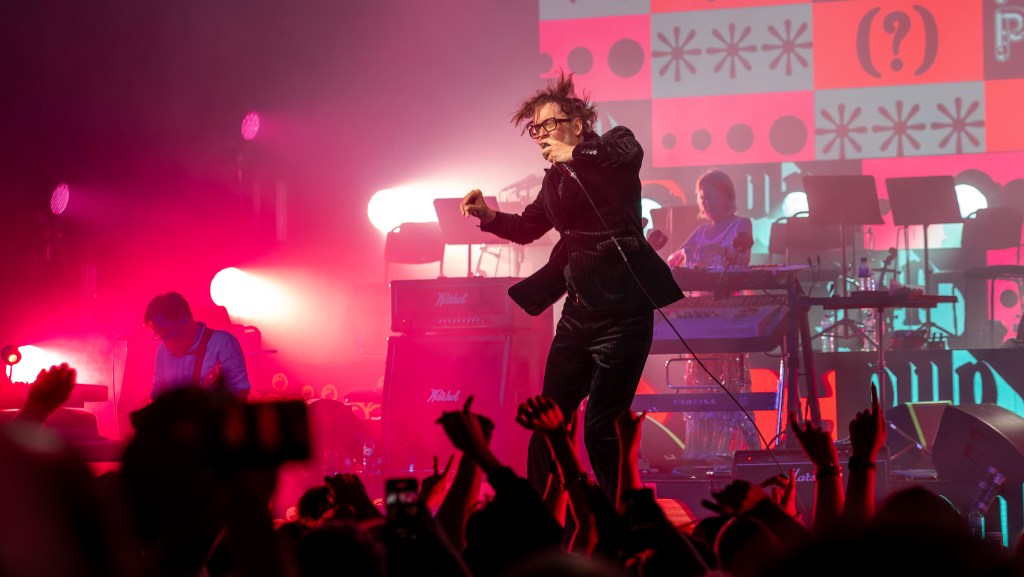
Pulp – Manchester, Co-op Live – 21/06/25
The British band has been a dying beast in popular music. Richard Osman made an interesting point on his podcast, that the first half of the ‘80s had over one hundred weeks of bands at #1, whereas the first half of the 2020s had only three: BBC Radio 1’s Live Lounge Allstars, The Beatles and Little Mix. So, really only one band in the truest sense; even then, a band with a mortality rate of 50% that hadn’t topped the charts in 54 years. Bands like Fontaines D.C. (dressed like a packet of chewed crayons) and Wunderhorse, perhaps The 1975 at a push, may be cited as counterpoints, but they hardly consist a widespread revival.
Yet, there is a clear appetite for the British band. Why else would Pulp and Oasis tour arenas this decade, or Blur record a concert film at Wembley, or the Cure reach the top of the album charts for the first time since 1992? If I were to be cynical, I might suggest that it’s more out of habit than anything else, our tendency to settle into the familiar, instinctively scratching the flea-ridden, mangy dog of nostalgia.
That being said, who can blame the British public for reverting back to the classics? Blur’s Wembley shows (or at least, the Saturday that I went to) were stellar, Britpop classics done proper justice. You can’t get much better than a choir-backed version of ‘Tender’, a Phil Daniels-fronted ‘Parklife’, or a mirrorball-bedazzled ‘The Universal’. Oasis, I’m sure, will put on a good show, and I’m certain that they’ll stick together for the full tour; not because of any brotherly love or reconciliation, but because they’ve made (and will continue to make) a fortune from ripping off their fans with immoral dynamic pricing and, inevitably, overpriced merchandise.
What about Pulp, the Lepidus of the Britpop Triumvirate? They, along with Suede, are the cool answer to ‘Blur or Oasis?’, the beloved curveball fronted by the erotic oddball, the self-defenestrator, wafter of bottoms, Jarvis Cocker. 1995’s Different Class cemented the band as cultural icons, grafting as they did since 1983’s It. They erred on the Blur side of Britpop, rattling out Kinks-inspired slice-of-life portraitures, imbued with their unique brand of slinky, synth pop combined with Cocker’s awkward, Jaggerish sexuality. ‘Common People’ has become a standard in the British musical canon, as has their stand-in headline slot at Glastonbury in 1995.
I was lucky enough to snaffle a few tickets for the last show of their tour’s UK leg, crammed into the pit of Manchester’s Co-op Live Arena. Just to get it out of the way now, it’s not a particularly good venue. When I saw Paul McCartney there before Christmas, the ‘Backstage Club’ area was a crammed room with barely any seating and yet a massive, empty dancefloor in the centre and a cordoned-off, also empty, extra-VIP seating area. To order food, you had to scan a QR code on a table, which meant having to impose yourself onto someone else’s table to scan, and wait at a serving hatch like a glorified motorway McDonald’s. There also doesn’t seem to be enough toilets. God knows how many people were late back during Pulp’s interval because a downstairs toilet was closed, leaving queues spilling out of the other two gent’s – the one I went to upstairs only had about eight urinals, which is baffling for a newly built arena with a capacity of upwards of 23,000. The pit bar ran out of beer before the show had even started too, and the escalator kept doing emergency stops because, as I heard a staff member say, ‘too many people were on it’ – bizarrely misdirected frustration to blame the customers (who are being charged almost £9 for a pint), and not the purpose-built, £450million arena.
Regardless, Pulp more than made up for all that nonsense. What a joy it was to see Jarvis Cocker rise from beneath the stage, poised as a cardboard silhouette, before jumping into ‘Spike Island’. The set was chocka with songs from their new album, More – ‘Got To Have Love’, ‘Farmer’s Market’, ‘Tina’, ‘Grown Ups’, ‘A Sunset’ – but, thankfully, they slotted seamlessly amongst their established ouvre.
The stage was set as a series of steps, each layer a row of light cubes on which various members of the band stood: the core Pulp members at the front, the string section (Elysian Collective) lined on the lefthand rows, and a few more musicians on the right. Cocker’s calves must have been on fire, slinking up and down the staircase throughout most songs. His age didn’t show, though; at 61 years of age, he still sang the songs with a vigour and wit that is unmistakably his own. He claimed that he couldn’t hit the high notes during the chorus of ‘Help the Aged’, but this seemed more a trick to encourage audience participation, as he easily hit the whimpers at the end of ‘Do You Remember the First Time?’.
There was little filler in the set, each break leading into the next track. The only was Jarvis Cocker throwing chocolate, grapes and teabags into the crowd, before failing to throw them into his own mouth. Other than this, the gig had three main highlights, song-wise. The first was ‘This Is Hardcore’, its brooding string sample adding a sleazy gravity to Jarvis’ every strut and flinch. Sonically, it is a fascinating and uneasy song, but it builds brilliantly, and the video playing behind Cocker was comprised of snippets from its iconic music video, topped visually only by the deep red which filled the stage from every light cube, like a rush and a push and a gush of blood from a nostril.
The second came straight after the midway interval. A curtain covered the first half’s set, and the core members of Pulp stood in front of it with their instruments (though Nick Banks is sat on a box rather than behind a drumkit). Cocker explained that, before deciding to tour for More, perhaps even before recording the album, they sat in a living room and wondered if they were still up to it. After performing a somewhat impromptu ‘Something Changed’, they decided to go ahead with their plans, and so they recreated that scene on stage. The minimalist framing added an intimacy, and the poignant mundanity and fragility of romance on which the lyrics touch is echoed by the band’s own reunion: the chance of failure and long history of choices that led them to that living room hold the same uncertainty as Cocker’s hypothetical cinema date. Eventually, one has to stop asking questions that don’t matter anyway, and appreciate the reality.
The last highlight, the crowd-pleaser, a song that may well have been some people’s only reason for seeing Pulp, was ‘Common People’. How can you not dance, jump, shout, feel a swelling of anger and indignity and pride at this song? The energy of its ever-increasing tempo, Candida Doyle’s supermarket-jingle keyboard riff, and Cocker’s acerbic wit, is enough to shake any dancefloor. But, for as good as the song is, and as much as the Co-op Live bounced with every violin sting, it’s hard to not be distracted by the surroundings: £80 for a standing ticket, £9 for a pint, £11.50 for a burger, £25 for parking. Even for relatively reasonably priced tickets, it’s difficult to feel real class injustice when you’re in the £365million cube next to the Etihad, and the person next to you is in a £65 hoodie from the merch stall, and you go back to your hotel after the show, and there are no cockroaches climbing the wall. Maybe, that’s the real power of the song. Cocker was singing not for us, but about us.
Pop your email below and never miss an article again!
 Argus Far
Leave a comment