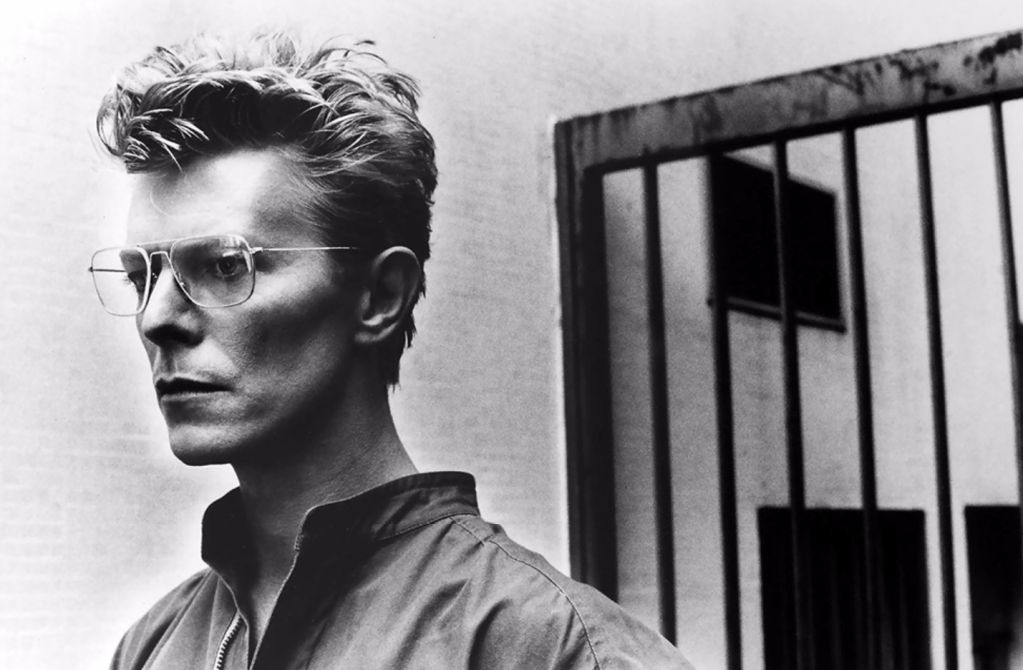
Following a number one single in the US and a worsening cocaine addiction, David Bowie moved to Europe. His albums Young Americans and Station to Station had cemented his fame in America, though his comments, made as his Thin White Duke persona, stirred controversy: ‘Adolf Hitler was one of the first rock stars,’ he said, before asserting, ‘Britain could benefit from a fascist leader.’ He was getting so high that he couldn’t even remember recording his albums. Something had to change, and so, alongside an equally coke-addled Iggy Pop, Bowie travelled across the Atlantic.
Europe was a complicated creature at the end of the 70s. It was stuck between an American rock and a Russian hard place, with Ronald Reagan stirring the ol’ Cold War pot, and though the physical effects of the Second World War had been mostly shaken off, it lurked in the public psyche like a hungry shadow. Musically, it was a transitional period. While Modernism was no longer modern, and new wave wasn’t particularly new, technological advances helped push popular music further than just 3-minute pop songs. The synthesizer gained a newfound prominence – Jean-Michel Jarre performed electronic music to over a million people in Paris – while Kraftwerk, The Fall, Tubeway Army and a slew of other artists were burgeoning cultural icons for their unorthodox music and alternative looks.
For Bowie, stepping away from America also meant stepping away from the music that defined his time there. The soul and funk of Young Americans and Station to Station were traded wholesale for the ambience, art rock and electronica of Low. Bowie sought the help of long-time collaborator Tony Visconti, as well as the Roxy Music co-founder Brian Eno, recording the album in France and West Berlin. Having already dabbled in these genres with Station to Station, as well as producing Iggy Pop’s The Idiot, Low was a confident, although commercially risky, effort for Bowie. The result was a landmark album. Innovative drumming techniques and glorious soundscapes crash together, producing fragments that flow and an atmosphere that at times feels airy, at others claustrophobic.
That same year, Bowie wrote and recorded Heroes. The most famous of the Berlin Trilogy, Heroes builds on Low’s electronic and ambient sounds, albeit with a more passionate and optimistic tone. It is the only album of the three which was fully recorded in Berlin, a city still divided between Western Europe and the Soviet Bloc. Many of the lyrics were written at the microphone, as Bowie had been impressed with Pop’s improvisational skills during the recording of Lust for Life, and so the streets of Berlin seep through with every word. The stark monoliths of Brutalist Berlin, many which still bore the bullet marks of recent conflict, cast the shadows in which Bowie walked, his songs echoing the city’s complicated past, troubled present, and uncertain future. The Berlin Wall was a particular influence on the title track, ‘Heroes’:
standing, by the wall/ And the guns shot above our head/ And we kissed, as though nothing could fall.
The concrete skyline under which this album was recorded asserts a statement of fact. It is permanent, bold and brooding. It is minimalist and maximalist, enormous slabs of grey stone carved with a deliberate brutality and simplicity. It is an indefinite, yet irresistible, dichotomy. Bowie knew this, singing on the opening track, ‘you can’t say no to the Beauty and the Beast.‘
Coming out of the comedown, Bowie travelled the world. He emerged from the chaos of Berlin for his Isolar II Tour, which saw him playing 78 shows across four continents. These shows were in somewhat intimate venues, with Bowie performing not as a character, like the Thin White Duke, but as himself. The final instalment of the Berlin Trilogy was recorded during the four-month break of the tour and is informed more by this period of travel than by the distant ambience and buzzing electronica of Low and Heroes. It is not without its own grimness or theatricality (‘Repetition’ has Bowie portray a remorseless wife-beater), but Lodger does have a more accessible and conventional sound, augmented by elements of world music. Mike Powell made an interesting comment regarding this album, that this was the ‘first David Bowie album marketed as nothing more than an album of recorded music by David Bowie’. He had shaken off what was left of the coke-addled Thin White Duke, introspected amongst the angular structures of a divided Berlin, and was about to enjoy the most commercially successful period of his career, releasing Scary Monsters (and Super Freaks)and Let’s Dance over the next four years.
Pop your email below and never miss an article again!
 Argus Far
Leave a comment